Section2.3Characteristics of a Function’s Graph (FN3)
Objectives
Use the graph of a function to find the domain and range in interval notation, the \(x\)- and \(y\)-intercepts, the maxima and minima, and where it is increasing and decreasing using interval notation.
Subsection2.3.1Activities
Remark2.3.1.
Definition2.3.2.
One of the easiest things to identify from a graph are the intercepts, which are points at which the graph crosses the axes. An \(x\)-intercept is a point at which the graph crosses the \(x\)-axis and a \(y\)-intercept is a point at which the graph crosses the \(y\)-axis. Because intercepts are points, they are typically written as an ordered pair: \((x,y)\text{.}\)
Activity2.3.3.
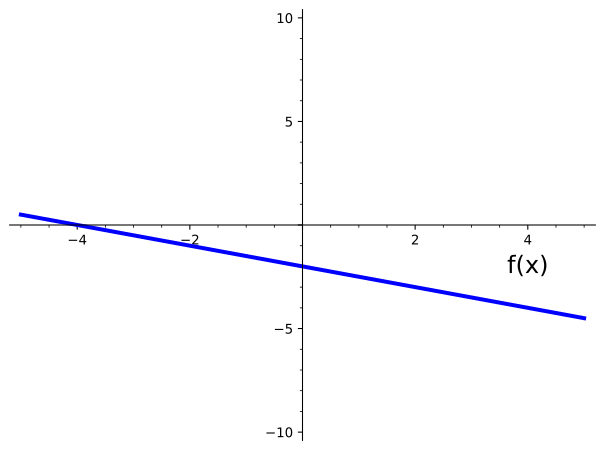
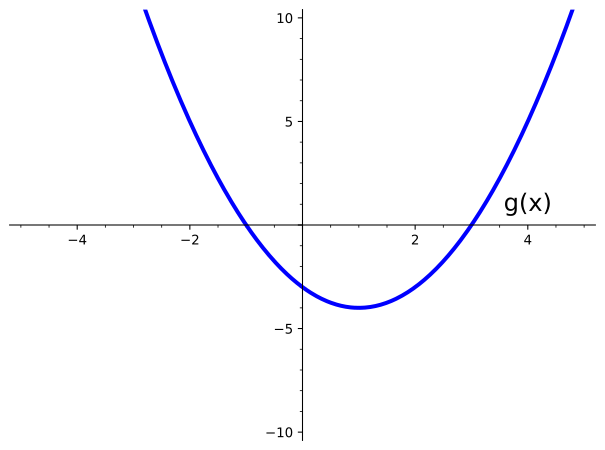
Use the following graphs to answer the questions.
(a)
What are the \(x\)-intercept(s) of \(f(x)\text{?}\)
\(\displaystyle (0, -4)\)
\(\displaystyle (-2, 0)\)
\(\displaystyle (-4, 0)\)
\(\displaystyle (0, -2)\)
Answer.
C
(b)
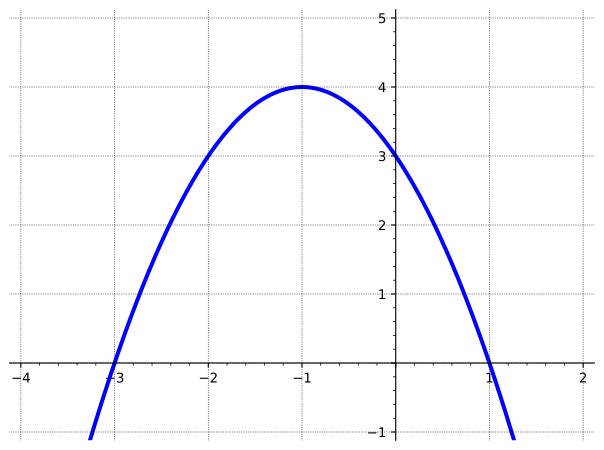
What are the \(x\)-intercept(s) of \(g(x)\text{?}\)
\(\displaystyle (0, -3)\)
\(\displaystyle (-1, 0)\)
\(\displaystyle (3, 0)\)
\(\displaystyle (-3, 0)\)
Answer.
B and C
(c)
What are the \(y\)-intercept(s) of \(f(x)\text{?}\)
\(\displaystyle (0, -4)\)
\(\displaystyle (-2, 0)\)
\(\displaystyle (-4, 0)\)
\(\displaystyle (0, -2)\)
Answer.
D
(d)
What are the \(y\)-intercept(s) of \(g(x)\text{?}\)
\(\displaystyle (0, -3)\)
\(\displaystyle (-1, 0)\)
\(\displaystyle (3, 0)\)
\(\displaystyle (-3, 0)\)
Answer.
A
(e)
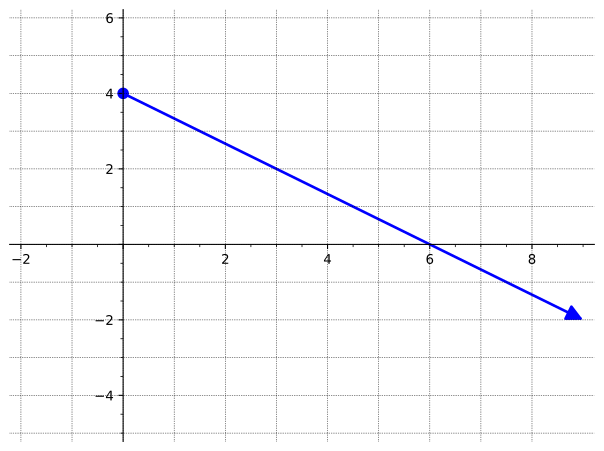
Sketch a graph of a function with the following intercepts:
\(x\)-intercepts: \((-2,0)\) and \((6,0)\)
\(y\)-intercept: \((0,4)\)
Answer.
Answers will vary. Students should make sure that their sketch is a function.
(f)
Sketch a graph of a function with the following intercepts:
\(x\)-intercept: \((-1,0)\)
\(y\)-intercept: \((0,6)\) and \((0,-2)\)
Answer.
You could draw a variety of graphs, but they would not be functions.
The domain refers to the set of possible input values and the range refers to the set of possible output values. If given a graph, however, it would be impossible to list out all the values for the domain and range so we use interval notation to represent the set of values.
Activity2.3.6.
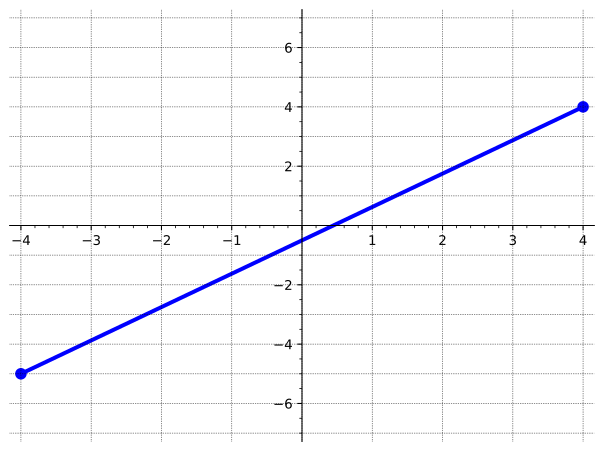
Use the following graph to answer the questions below.
Figure2.3.7.
(a)
Draw on the \(x\)-axis all the values in the domain.
Answer.
Students should shade all values of \(x\) from \(-4\) to \(4\text{.}\) The intent here is to help students visualize that the domain consists of more than \(x\)-values that are integers.
(b)
What interval represents the domain you drew in part (a)?
\(\displaystyle [4, -4]\)
\(\displaystyle [-4, 4]\)
\(\displaystyle (-4, 4)\)
\(\displaystyle (4, -4)\)
Answer.
B
(c)
Draw on the \(y\)-axis all the values in the range.
Answer.
Students should shade all values of \(y\) from \(-5\) to \(4\text{.}\) The intent here is to help students visualize that the range consists of more than \(y\)-values that are integers.
(d)
What interval represents the range you drew in part (c)?
\(\displaystyle (-5, 4)\)
\(\displaystyle [-4, 4]\)
\(\displaystyle [-5, 4]\)
\(\displaystyle (4, -5)\)
Answer.
C
Activity2.3.8.
Use the following graph to answer the questions below.
Figure2.3.9.
(a)
What is the domain of this graph?
\(\displaystyle [4, \infty)\)
\(\displaystyle (-\infty, 0]\)
\(\displaystyle (-\infty, 4]\)
\(\displaystyle [0, \infty)\)
Answer.
D
(b)
What is the range of this graph?
\(\displaystyle [4, \infty)\)
\(\displaystyle (-\infty, 0]\)
\(\displaystyle (-\infty, 4]\)
\(\displaystyle [0, \infty)\)
Answer.
C
Remark2.3.10.
\([4,-\infty)\)\(-\infty\)\(4\text{.}\)
For domain, read the graph from left to right. For range, read the graph from bottom to top.
Activity2.3.11.
Use the following graph to answer the questions below.
Figure2.3.12.
(a)
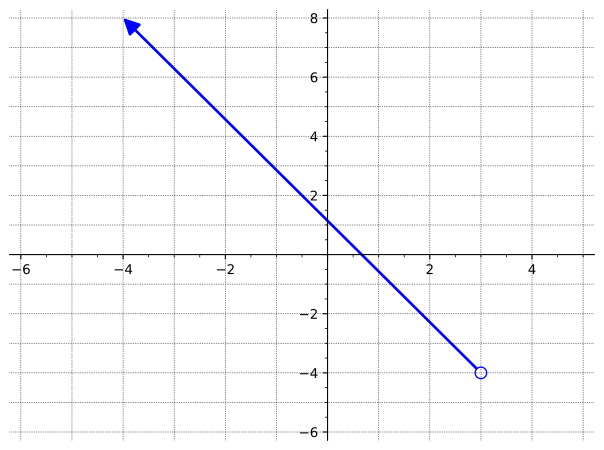
What is the domain of this graph?
\(\displaystyle (-\infty, 3)\)
\(\displaystyle (\infty, -4]\)
\(\displaystyle (-4, \infty)\)
\(\displaystyle (-\infty, 3]\)
Answer.
A
(b)
What is the range of this graph?
\(\displaystyle (-\infty, 3)\)
\(\displaystyle (\infty, -4]\)
\(\displaystyle (-4, \infty)\)
\(\displaystyle (-\infty, 3]\)
Answer.
C
Activity2.3.13.
Use the following graph to answer the questions below.
Figure2.3.14.
(a)
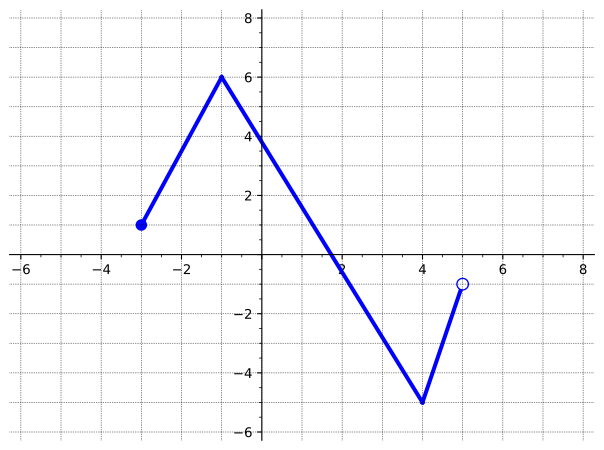
What is the domain of this graph?
\(\displaystyle (-3, 5)\)
\(\displaystyle (-5, 7)\)
\(\displaystyle [-5, 7]\)
\(\displaystyle [-3,5)\)
Answer.
D
(b)
What is the range of this graph?
\(\displaystyle (-3, 5)\)
\(\displaystyle (-5, 6)\)
\(\displaystyle [-5, 6]\)
\(\displaystyle [-3,5)\)
Answer.
C
Remark2.3.15.
\(x\)\(y\)
Activity2.3.16.
In this activity, we will look at where the function is increasing and decreasing. Use the following graph to answer the questions below.
(a)
Where do you think the graph is increasing?
Answer.
The function is increasing from \((-\infty, -1)\text{.}\) Instructors can emphasize this by having students think about where the function is "going up." It may be helpful to also note that the function is no longer "going up" once you get to the "top". This could help students think about how to write their answer in interval notation (with parentheses and not brackets).
(b)
Which interval best represents where the function is increasing?
\(\displaystyle (-\infty, -1]\)
\(\displaystyle (-\infty, -1)\)
\(\displaystyle (-1,\infty)\)
\(\displaystyle [-1,\infty)\)
Answer.
B
(c)
Where do you think the graph is decreasing?
Answer.
The function is decreasing from \((-1, \infty)\text{.}\) Instructors can emphasize this by having students think about where the function is "going down." It may be helpful to also note that the function is no longer "going down" once you get to the "bottom". In this case, the "bottom" does not exist...This might be a good opportunity to discuss with students how to address this when writing the range in interval notation.
(d)
Which interval best represents where the function is decreasing?
\(\displaystyle (-\infty, -1]\)
\(\displaystyle (-\infty, -1)\)
\(\displaystyle (-1,\infty)\)
\(\displaystyle [-1,\infty)\)
Answer.
C
(e)
Based on what you see on the graph, do you think this graph has any maxima or minima?
Answer.
The intent here is for students to visually see there that the graph reaches a high point (i.e., the maximum). To extend this thinking, instructors could also ask students to draw a sketch (or discuss) when a graph would have a minimum.
Definition2.3.17.
As you noticed in Activity 2.3.16, functions can increase or decrease (or even remain constant!) for a period of time. The interval of increase is when the \(y\)-values of the function increase as the \(x\)-values increase. The interval of decrease is when the \(y\)-values of the function decrease as the \(x\)-values increase. The function is constant when the \(y\)-values remain constant as \(x\)-values increase (also known as the constant interval).
The easiest way to identify these intervals is to read the graph from left to right and look at what is happening to the \(y\)-values.
Definition2.3.18.
The maximum, or global maximum, of a graph is the point where the \(y\)-coordinate has the largest value. The minimum, or global minimum is the point on the graph where the \(y\)-coordinate has the smallest value.
Graphs can also have local maximums and local minimums. A local maximum point is a point where the function value (i.e, \(y\)-value) is larger than all others in some neighborhood around the point. Similarly, a local minimum point is a point where the function value (i.e, \(y\)-value) is smaller than all others in some neighborhood around the point.
Remark2.3.19.
Global extrema are sometimes referred to as absolute extrema, while local extrema are sometimes referred to as relative extrema.
Activity2.3.20.
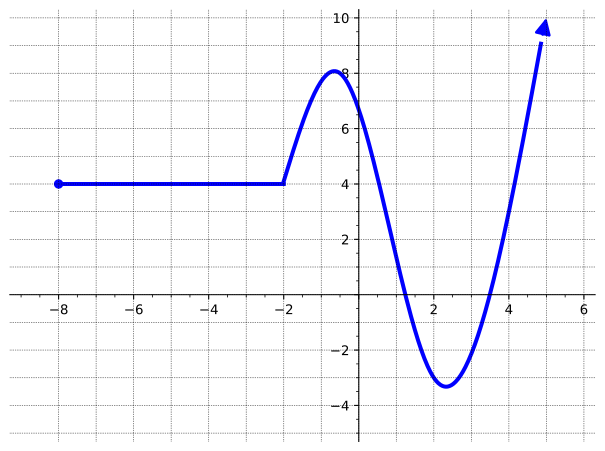
Use the following graph to answer the questions below.
Figure2.3.21.
(a)
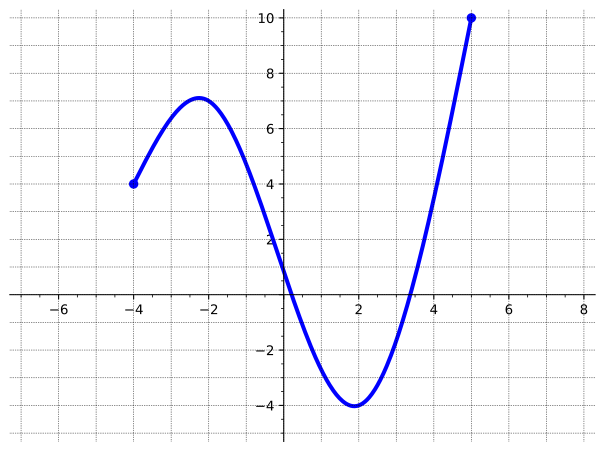
At what value of \(x\) is there a global maximum?
\(\displaystyle x=-4\)
\(\displaystyle x=-2\)
\(\displaystyle x=2\)
\(\displaystyle x=5\)
Answer.
D
(b)
What is the global maximum value?
\(\displaystyle 10\)
\(\displaystyle 7\)
\(\displaystyle 4\)
\(\displaystyle -4\)
Answer.
A
(c)
At what value of \(x\) is there a global minimum?
\(\displaystyle x=-4\)
\(\displaystyle x=-2\)
\(\displaystyle x=2\)
\(\displaystyle x=5\)
Answer.
C
(d)
What is the global minimum value?
\(\displaystyle 10\)
\(\displaystyle 7\)
\(\displaystyle 4\)
\(\displaystyle -4\)
Answer.
D
(e)
At approximately what value of \(x\) is there a local maximum?
\(\displaystyle x \approx -4\)
\(\displaystyle x \approx -2\)
\(\displaystyle x \approx 2\)
\(\displaystyle x \approx 5\)
Answer.
B
(f)
What is the local maximum value?
\(\displaystyle 10\)
\(\displaystyle 7\)
\(\displaystyle 4\)
\(\displaystyle -4\)
Answer.
B
(g)
At approximately what value of \(x\) is there a local minimum?