Determine an equation for a line when given two points on the line and when given the slope and one point on the line. Express these equations in slope-intercept or point-slope form and determine the slope and y-intercept of a line given an equation.
Subsection3.2.1Activities
Activity3.2.1.
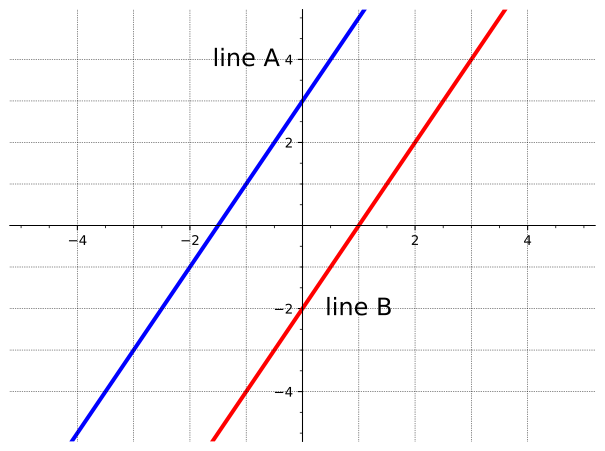
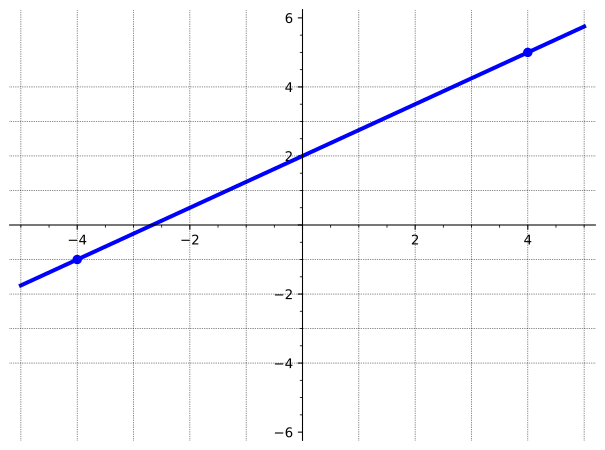
Consider the graph of two lines.
(a)
Find the slope of line A.
\(\displaystyle 1\)
\(\displaystyle 2\)
\(\displaystyle \dfrac{1}{2} \)
\(\displaystyle -2\)
Answer.
B
(b)
Find the slope of line B.
1
2
\(\displaystyle \dfrac{1}{2} \)
\(\displaystyle -2\)
Answer.
B
(c)
Find the \(y\)-intercept of line A.
\(\displaystyle -2\)
\(\displaystyle -1.5\)
\(\displaystyle 1 \)
\(\displaystyle 3\)
Answer.
D
(d)
Find the \(y\)-intercept of line B.
\(\displaystyle -2\)
\(\displaystyle -1.5\)
\(\displaystyle 1 \)
\(\displaystyle 3\)
Answer.
A
(e)
What is the same about the two lines?
Answer.
Lines A and B have the same slope.
(f)
What is different about the two lines?
Answer.
Lines A and B have different \(y\)-intercepts.
Remark3.2.2.
Notice that in Activity 3.2.1 the lines have the same slope but different \(y\)-intercepts. It is not enough to just know one piece of information to determine a line, you need both a slope and a point.
Definition3.2.3.
Linear functions can be written in slope-intercept form
\begin{equation*}
f(x)=mx+b
\end{equation*}
where \(b\) is the \(y\)-intercept (or starting value) and \(m\) is the slope (or constant rate of change).
Activity3.2.4.
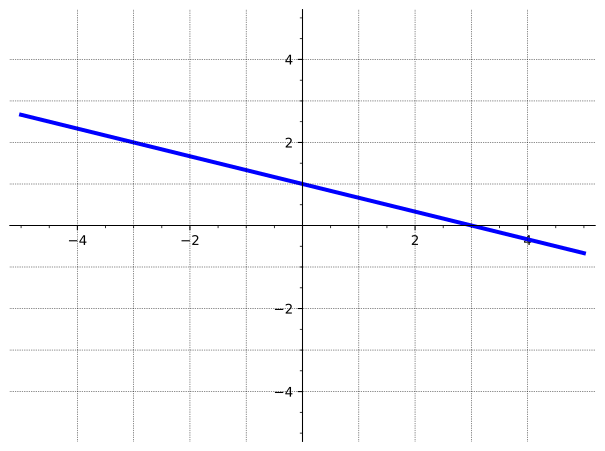
Write the equation of each line in slope-intercept form.
(a)
\(\displaystyle y= -3x+1\)
\(\displaystyle y= -x+3\)
\(\displaystyle y= -\dfrac{1}{3}x+1\)
\(\displaystyle y= -\dfrac{1}{3}x+3\)
Answer.
C
(b)
The slope is \(4\) and the \(y\)-intercept is \((0,-3)\text{.}\)
\(\displaystyle f(x)= 4x-3\)
\(\displaystyle f(x)= 3x-4\)
\(\displaystyle f(x)= -4x+3\)
\(\displaystyle f(x)= 4x+3\)
Answer.
A
(c)
Two points on the line are \((0,1)\) and \((2,4)\text{.}\)
\(\displaystyle y= 2x+1\)
\(\displaystyle y= -\dfrac{3}{2}x+4\)
\(\displaystyle y= \dfrac{3}{2}x+1\)
\(\displaystyle y= \dfrac{3}{2}x+4\)
Answer.
C
(d)
\(x\)
\(f(x)\)
\(-2\)
\(-8\)
\(0\)
\(-2\)
\(1\)
\(1\)
\(4\)
\(10\)
\(\displaystyle f(x)= -3x-2\)
\(\displaystyle f(x)= -\dfrac{1}{3}x-2\)
\(\displaystyle f(x)= 3x+1\)
\(\displaystyle f(x)= 3x-2\)
Answer.
D
Activity3.2.5.
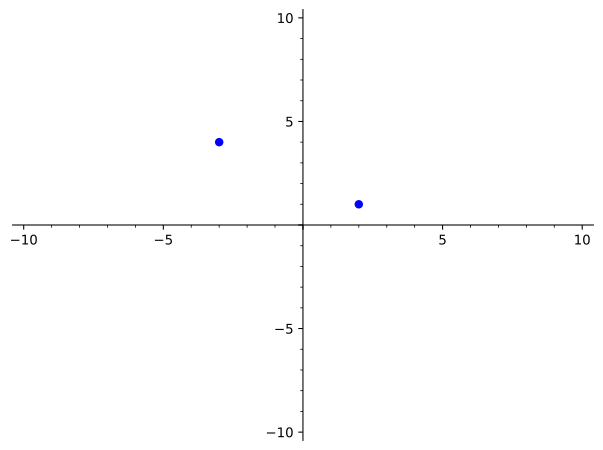
Let’s try to write the equation of a line given two points that don’t include the \(y\)-intercept.
(a)
Plot the points \((2,1)\) and \((-3,4)\text{.}\)
Answer.
(b)
Find the slope of the line joining the points.
\(\displaystyle -\dfrac{5}{3}\)
\(\displaystyle -\dfrac{3}{5}\)
\(\displaystyle \dfrac{3}{5}\)
\(\displaystyle -3\)
Answer.
B
(c)
When you draw a line connecting the two points, it’s often hard to draw an accurate enough graph to determine the \(y\)-intercept of the line exactly. Let’s use the slope-intercept form and one of the given points to solve for the \(y\)-intercept. Try using the slope and one of the points on the line to solve the equation \(y=mx+b\) for \(b\text{.}\)
\(\displaystyle 2\)
\(\displaystyle \dfrac{11}{5}\)
\(\displaystyle \dfrac{5}{2}\)
\(\displaystyle 3\)
Answer.
B
(d)
Write the equation of the line in slope-intercept form.
Answer.
\(y=-\dfrac{3}{5}x+\dfrac{11}{5}\)
Remark3.2.6.
\(y\)
Definition3.2.7.
Linear functions can be written in point-slope form
\begin{equation*}
y-y_0=m(x-x_0)
\end{equation*}
where \((x_0, y_0)\) is any point on the line and \(m\) is the slope.
Activity3.2.8.
Write an equation of each line in point-slope form.
(a)
\(\displaystyle y= \dfrac{1}{3}x+\dfrac{2}{3}\)
\(\displaystyle y-1= 3(x-1)\)
\(\displaystyle y-1= \dfrac{1}{3}(x-1)\)
\(\displaystyle y+2= \dfrac{1}{3}(x+2)\)
\(\displaystyle y= \dfrac{1}{3}(x+2)\)
Answer.
C or E
(b)
The slope is \(4\) and \((-1,-7)\) is a point on the line.
\(\displaystyle y+7= 4(x+1)\)
\(\displaystyle y-7= 4(x-1)\)
\(\displaystyle y+1= 4(x+7)\)
\(\displaystyle y-4= 7(x-1)\)
Answer.
A
(c)
Two points on the line are \((1,0)\) and \((2,-4)\text{.}\)
\(\displaystyle y= -4x+1\)
\(\displaystyle y-0=-2(x-1) \)
\(\displaystyle y+4=-4(x-2)\)
\(\displaystyle y+4=-3(x-2)\)
Answer.
C
(d)
\(x\)
\(f(x)\)
\(-2\)
\(-8\)
\(1\)
\(1\)
\(4\)
\(10\)
\(\displaystyle y+8= 3(x-2)\)
\(\displaystyle y-1= -\dfrac{1}{3}(x-1)\)
\(\displaystyle y+8= -\dfrac{1}{3}(x+2)\)
\(\displaystyle y-10= 3(x-4)\)
Answer.
D
Activity3.2.9.
Consider again the two points from Activity 3.2.5, \((2,1)\) and \((-3,4)\text{.}\)
(a)
Use point-slope form to find an equation of the line.
\(\displaystyle y=-\dfrac{3}{5}x+\dfrac{11}{5}\)
\(\displaystyle y-1=-\dfrac{3}{5}(x-2)\)
\(\displaystyle y-4 =-\dfrac{3}{5}(x+3)\)
\(\displaystyle y-2=-\dfrac{3}{5}(x-1) \)
Answer.
B or C
(b)
Solve the point-slope form of the equation for \(y\) to rewrite the equation in slope-intercept form. Identify the slope and intercept of the line.
Answer.
The slope-intercept form is: \(y=-\dfrac{3}{5}x+\dfrac{11}{5}\text{.}\) The slope is \(-\dfrac{3}{5}\) and the \(y\)-intercept is \(\dfrac{11}{5}\text{.}\)
Remark3.2.10.
Activity3.2.11.
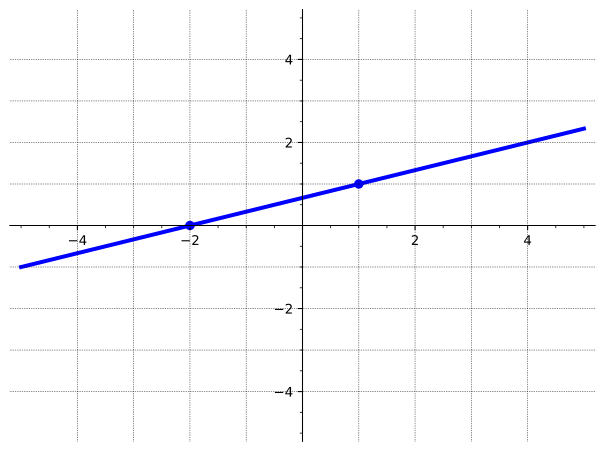
For each of the following lines, determine which form (point-slope or slope-intercept) would be "easier" and why. Then, write the equation of each line.
(a)
Answer.
Slope-intercept: \(y=\dfrac{3}{4}x+2\)
(b)
The slope is \(-\dfrac{1}{2}\) and \((1,-3)\) is a point on the line.
Answer.
Point-slope: \(y+3=-\dfrac{1}{2}(x-1)\)
(c)
Two points on the line are \((0,3)\) and \((2,0)\text{.}\)
Answer.
Slope-intercept: \(y=-\dfrac{3}{2}x+3\)
Remark3.2.12.
Activity3.2.13.
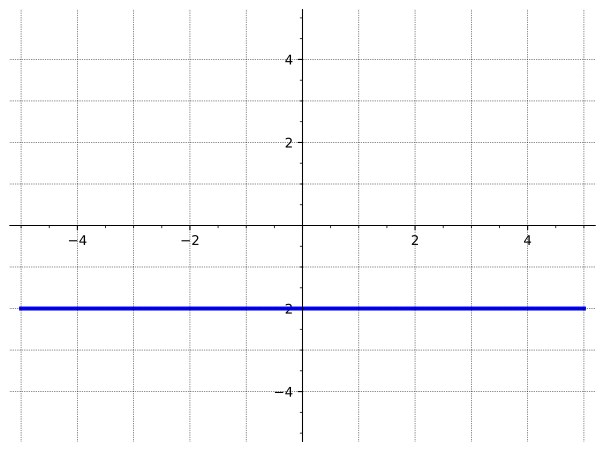
Write the equation of each line.
(a)
The slope is \(0\) and \((-1,-7)\) is a point on the line.
\(\displaystyle y=-7\)
\(\displaystyle y=7x\)
\(\displaystyle y=-x\)
\(\displaystyle x=-1\)
Answer.
A
(b)
Two points on the line are \((3,0)\) and \((3,5)\text{.}\)
\(\displaystyle y=3x+3\)
\(\displaystyle y=3x+5 \)
\(\displaystyle x=3\)
\(\displaystyle y=3\)
Answer.
C
(c)
\(\displaystyle x=-2 \)
\(\displaystyle y-2=x\)
\(\displaystyle y=-2x-2\)
\(\displaystyle y=-2\)
Answer.
D
Definition3.2.14.
A horizontal line has a slope of zero and has the form \(y=k\) where \(k\) is a constant. A vertical line has an undefined slope and has the form \(x=h\) where \(h\) is a constant.
Definition3.2.15.
The equation of a line can also be written in standard form. Standard form looks like \(Ax+By=C\text{.}\)